Case Studies
The Envelope That Closed the Deal: A Founder's Story of Presence
When architect Priya Malhotra walked into her most important pitch, it wasn't her portfolio that impressed the client first. It was the envelope it arrived in.
The Moment Before the Words
The conference room on the fourteenth floor of a Bandra Kurla Complex tower smelled of cold air and ambition. Priya Malhotra, founder of Malhotra Studio, a boutique architectural practice based in Mumbai, set her materials on the table before the clients arrived. A set of rendered drawings. A detailed proposal. A site analysis, printed clean on A4, each page carrying three years of accumulated expertise.
She had carried them in a Portfolio A4 envelope from Chhapai. Ivory, letterpress-printed with her studio's name in a single, composed typeface. No crease ran across the pages. No corner had bent in transit. When she slid the envelope across the polished table, the lead partner picked it up before opening it, turned it over once in his hands, and said nothing for a moment.
"You know," he said finally, "most people email us a PDF."
That pause, that small act of noticing, is what Priya had been working toward for two years.
What the Work Required
Priya established Malhotra Studio in 2019 after a decade at larger practices in Delhi and Singapore. The transition to independent work brought freedoms she had long imagined, but it also brought a particular, persistent problem. She was competing with firms that had thirty people, polished websites, and decades of brand recognition. She had herself, two collaborators, and a portfolio of six completed projects that she believed, deeply, were extraordinary.
The work was not the problem. Communication was.
"I kept sending proposals and not hearing back," she recalled. "Or I would hear back weeks later, almost apologetically, as if my submission had been misplaced in someone's inbox. I started to wonder if the work was arriving the way I intended it to."
Architectural proposals are not short documents. A serious submission from Malhotra Studio runs twelve to twenty pages: site studies, material specifications, spatial narratives, fee structures. Folding those pages into a standard business envelope felt, to Priya, like rolling a painting into a tube. The content survived. The dignity did not.
She needed her work to arrive intact, composed, and with the same authority it carried when she finished it at her desk at midnight.
The Craft Behind the Carrier
An Envelope as an Object
Chhapai's Portfolio A4 envelope was not designed as an afterthought to the documents it carries. It was designed around them. At nine by twelve inches, it accommodates full A4 sheets without asking them to compromise their form. The proportions are deliberate: clean edges, balanced width, a flap that closes with the quiet certainty of something made to last a single, important journey.
The paper stock carries tooth. Not roughness, but character. When Priya ran her fingertips across the first sample Chhapai sent her, she described it as feeling like the cover of a book that someone had spent time choosing. The weight sat in the hand differently from commercial alternatives. It communicated, before a word was read, that what was inside had been treated with care.
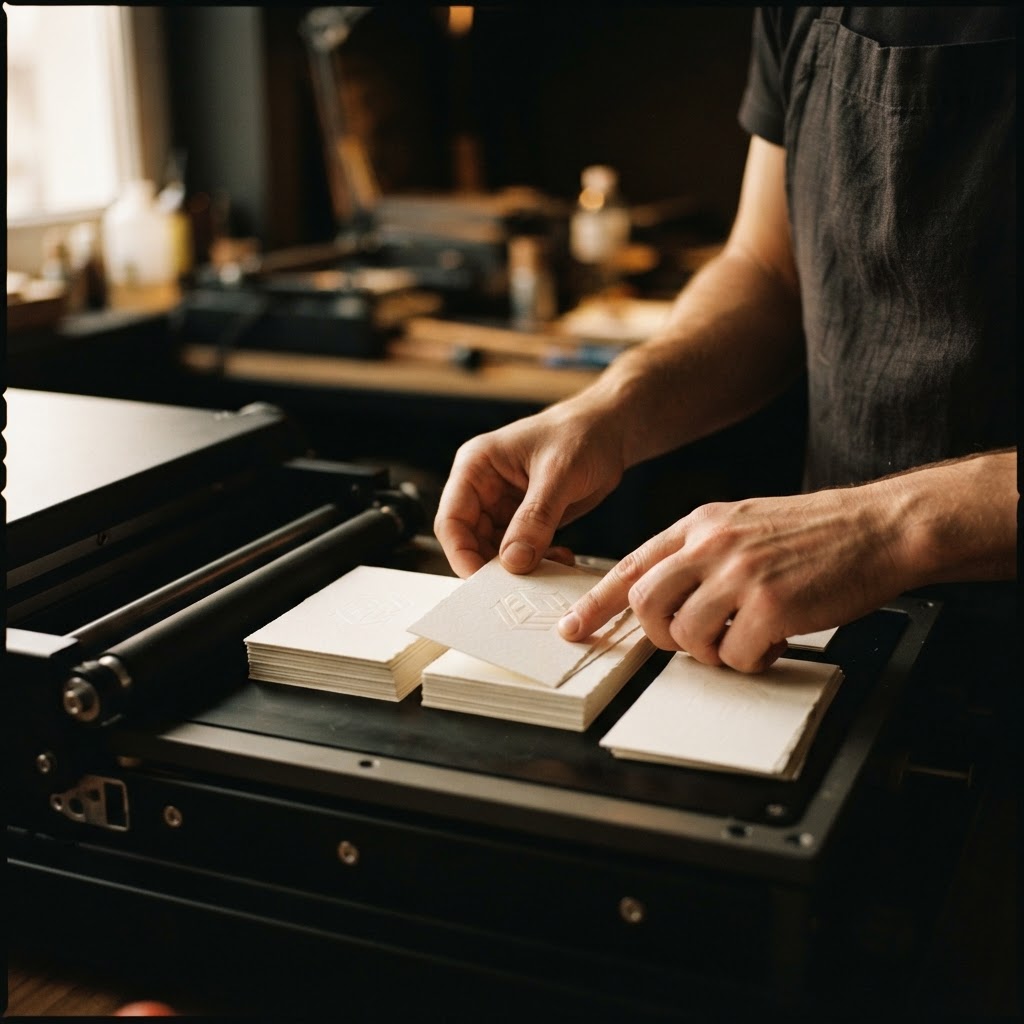
The letterpress printing is done the way it has been done at Chhapai's Jaipur atelier since 2006: with pressure, with intention, with ink that sits in the paper rather than resting on top of it. Priya's studio mark, a small geometric device of her own design, was pressed into the lower left corner of each envelope. Not printed. Pressed. The impression is shallow enough to miss in poor light, and visible enough that anyone who notices it understands, instinctively, that this is not mass-produced stationery.
Some work should never be folded. The Portfolio A4 envelope exists precisely for that conviction, for proposals, contracts, and presentations that deserve to arrive the way they were made: whole, flat, and without apology.
Why the Format Matters
There is a category error that happens frequently in professional presentation. People spend months on a proposal and thirty seconds deciding how to send it. The document becomes the priority; the vessel becomes invisible. But a recipient encounters the vessel first. They feel its weight, register its surface, read its proportions before they read a single word inside. The envelope is not packaging. It is the opening sentence of a conversation.
Chhapai's Portfolio A4 is sized not merely to fit A4 paper but to frame it. The small margin of space around the document prevents shifting in transit. Pages arrive as they were placed. A4 rendered drawings do not acquire diagonal shadows from a crease crossing the page. A fee proposal does not arrive with a fold line bisecting the numbers.
This is not a small thing. In Priya's experience, it became a significant one.
What Changed
The Bandra Kurla Complex meeting was the third proposal Priya had submitted using the Chhapai envelope. The first had gone to a residential client in Pune, a couple commissioning a weekend home. They had called her the afternoon the envelope arrived. Not to confirm receipt, as clients often did with digital submissions, but to say they had read the whole proposal that evening and wanted to meet that week. The wife had kept the envelope on her desk. Priya noticed it there when she visited for the site briefing.
The second had gone to a heritage hotel group considering a restoration commission in Rajasthan. The project director, a meticulous man who had been working with international firms for twenty years, mentioned the envelope specifically in his email reply. He said it suggested Malhotra Studio understood the nature of the project before they had even spoken about it.
And the fourteenth floor meeting in Bandra ended with a commission. A mixed-use development in Thane, the largest project Priya's studio had ever undertaken. The lead partner later told her that her proposal had been the only physical submission they received. The rest had been PDFs, opened briefly on a laptop screen and largely forgotten by the time the meeting began. Priya's pages had been distributed around the table. People had marked them with pencil. They had carried the conversation in a way that a shared screen could not.
"I am not a nostalgist," Priya said. "I do not send physical proposals because I distrust technology. I send them because I know what it feels like to hold something that has been made carefully, and I want my clients to feel that about my work before they read a word of it."
The Referral That Confirmed It
Six months after the Thane commission began, Priya received an inquiry from a developer she had never contacted. He had seen her proposal envelope at the offices of the Bandra Kurla client, he said, and had asked about her. He did not mention her website. He did not mention her Instagram, where she documented her projects with considerable care. He mentioned the envelope.
She found this instructive. A physical object had circulated in spaces she could not reach digitally. It had been picked up, remarked upon, remembered. It had done what good design always does: it worked without explanation.
A Quiet Confidence
Priya orders her Chhapai Portfolio A4 envelopes in batches of fifty. She uses them for initial proposals, for contracts sent at project start, and for the bound documentation she provides at project completion, a full record of the work, delivered as a final gesture of regard for what has been built together. Each envelope leaves her studio with the same pressed mark in the lower left corner. Each one carries documents that have not been folded.
There are architects with larger studios and larger budgets who present their work with considerably less care. Priya does not remark on this. She has simply found that the clients she most wants to work with, the ones who are serious about what they are building, respond to seriousness in kind. The envelope is a signal. It selects for the right room.
At Chhapai, we have made stationery for founders, architects, lawyers, curators, and collectors since 2006. We have learned, over nearly two decades at our Jaipur atelier, that the objects surrounding a business are never neutral. They speak before the founder does. They remain after the meeting ends. They travel to desks and shelves and conference rooms that the founder will never see.
The Portfolio A4 envelope was made for work that deserves that kind of presence. For proposals that represent months of thinking. For contracts that mark the beginning of something real. For the documents that, when they arrive flat and composed and beautiful, tell a client everything they need to know about the person who sent them.
Some work should never be folded. And the people who understand that tend to do very fine work indeed.