Case Studies
The Card That Carried Her Conviction: A Story of Renew Archive
When Mumbai architect Priya Nair handed over her first Chhapai card, the paper said everything her pitch deck could not. A story of material integrity and quiet brand confidence.
The Moment the Paper Spoke First
It was a Thursday afternoon in a glass-walled conference room in Bandra Kurla Complex. Priya Nair, founder of Foundwork Studio, a sustainable architecture practice, had just finished her presentation to a hospitality group looking to develop a resort in Coorg. The slides had closed. The room had gone to that particular silence that follows a good pitch. And then she placed her card on the table.
The executive across from her picked it up. She turned it over once. Then again. She held it at the light and ran her thumb across its surface. The texture was unmistakable, not rough, not smooth, but present. Like the grain of handmade paper without its rusticity. Like something that had been made with patience.
"What is this printed on?" the executive asked.
Priya had been asked that question seven times in four months. Each time, the answer led somewhere good.
What She Needed the Card to Say
Priya had spent two years building Foundwork Studio on a single conviction: that beautiful spaces and responsible materials are not in opposition. Her projects used reclaimed wood, locally sourced stone, and low-carbon concrete. Her practice had won a regional award. Her clients were beginning to include names people recognised. And yet she kept arriving at the same friction point. The moment she handed over her old cards, the slick laminated stock from a print aggregator, something in the conversation shifted. Subtly. Almost imperceptibly. But she felt it.
The card communicated speed, volume, convenience. Everything her practice was not.
"I had spent so much time thinking about what I build," she told us. "I had not thought about what I hand people before they ever see the work."
She came to Chhapai in the winter of 2023, referred by a furniture designer in Pune who had used our letterpress cotton cards for a collection launch. Priya's brief was precise: she wanted a card that felt like it had a philosophy. She did not want it to shout. She wanted it to hold its ground quietly.
The Material and Its Making
A Paper With History Woven In
When our team introduced Priya to Renew Archive, the conversation changed register. This is not a paper we describe the same way we describe cotton or bamboo. Renew Archive carries something different. It arrives at our Jaipur atelier from Favini, a mill in northern Italy with roots that stretch back to 1736. Favini is not a supplier. They are, by any honest measure, one of the most thoughtful paper makers working in Europe today.
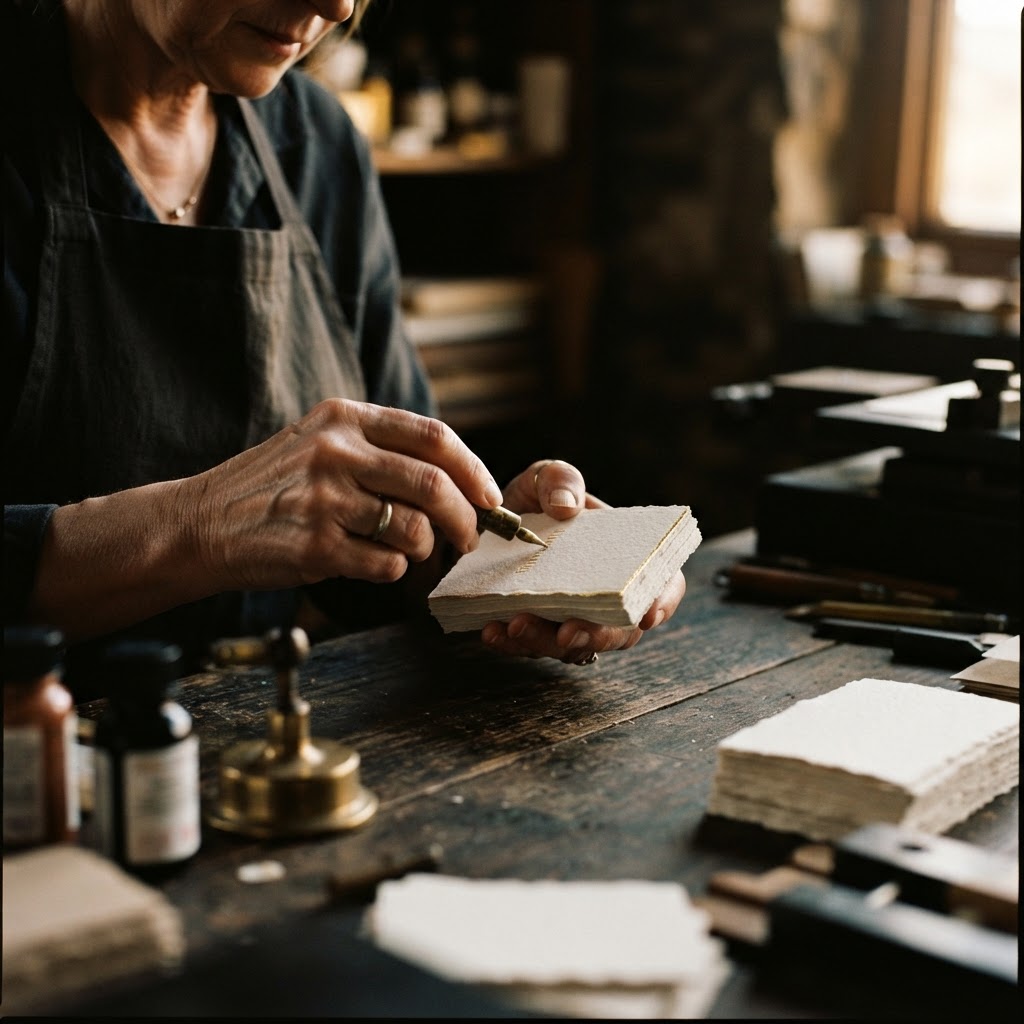
Renew Archive is made from recycled pulp fibers, paper that has already lived one life and been given another. The process strips back what is unnecessary and returns something that is cleaner, quieter, more considered. The result is a sheet with a slightly textured finish, not aggressively tactile, but present in the hand. Hold a Renew Archive card and you feel the surface as a landscape, fine and consistent, with just enough tooth to slow the fingertip.
The weight, the density, the way light catches its face without glare. These are not accidents. They are the consequence of decades of paper science applied with restraint.
What Chhapai Does With That Foundation
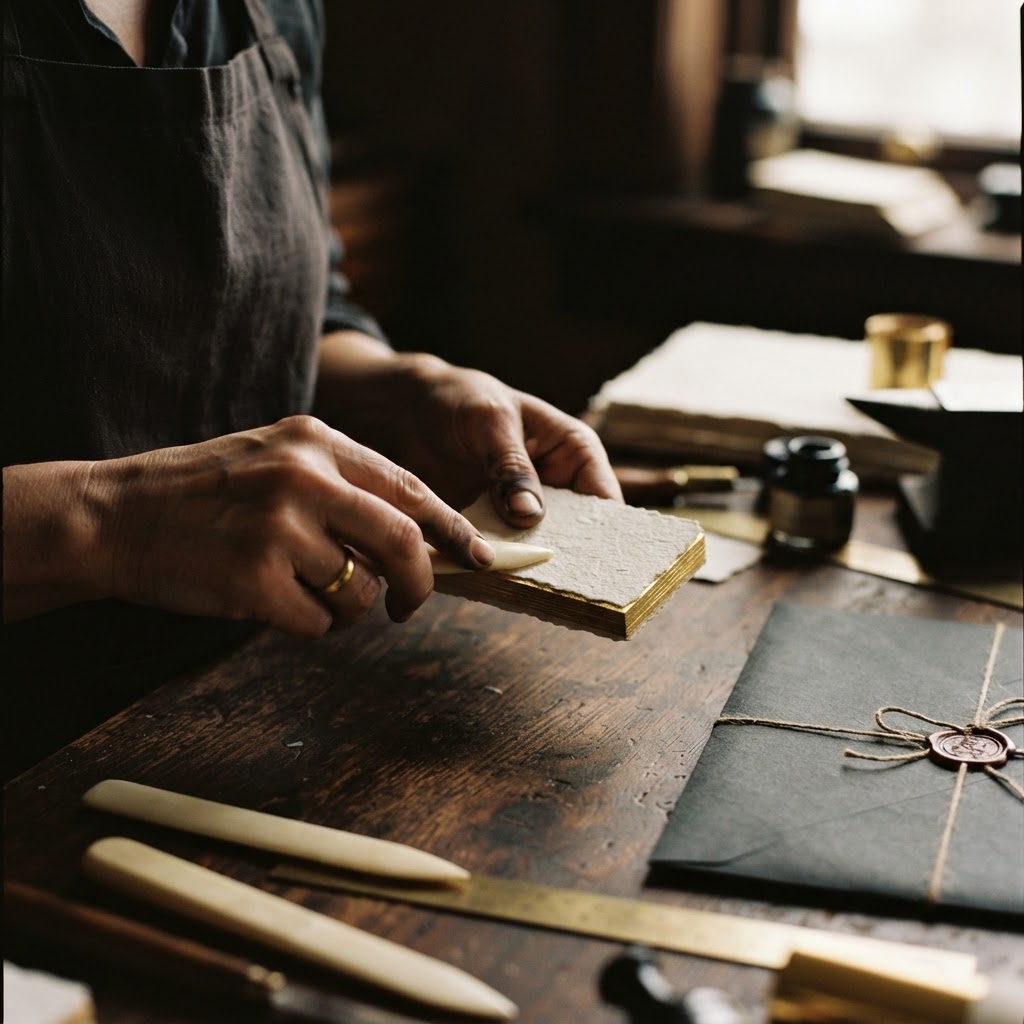
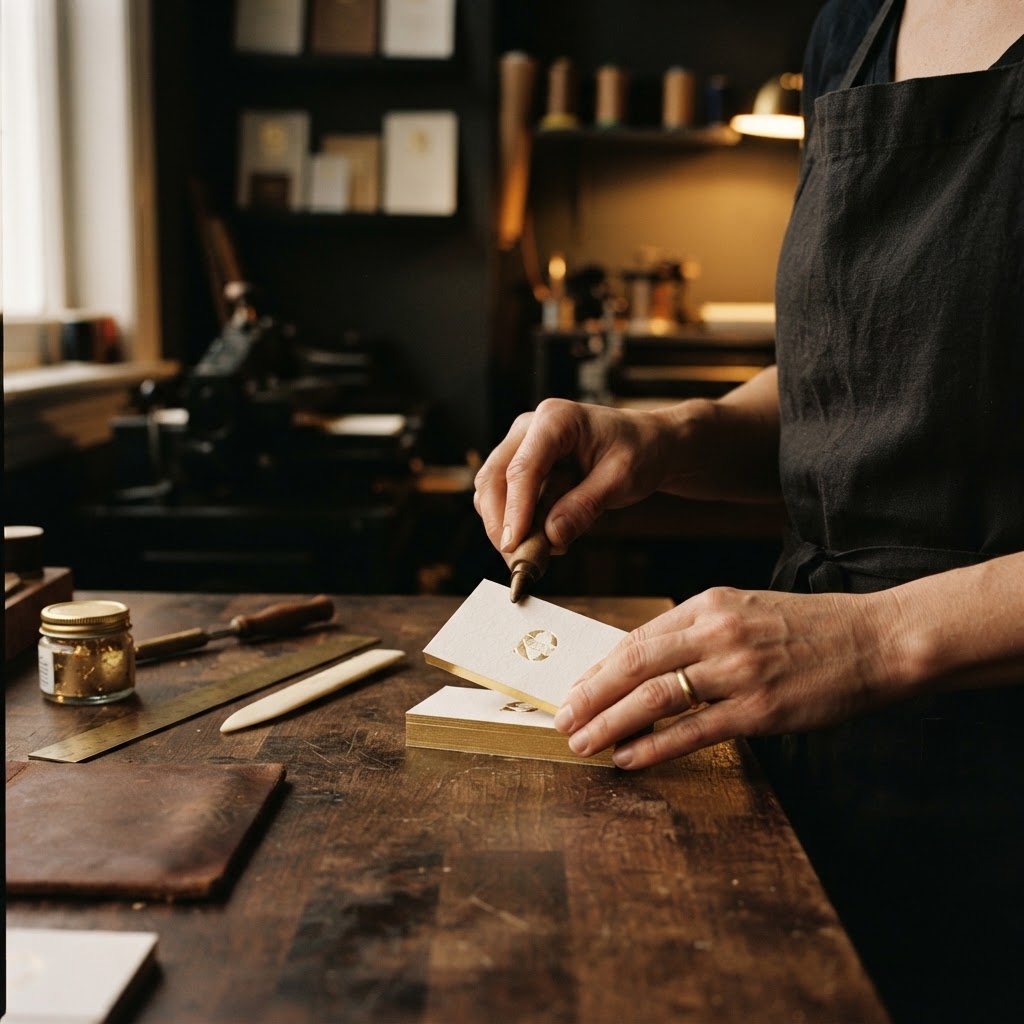
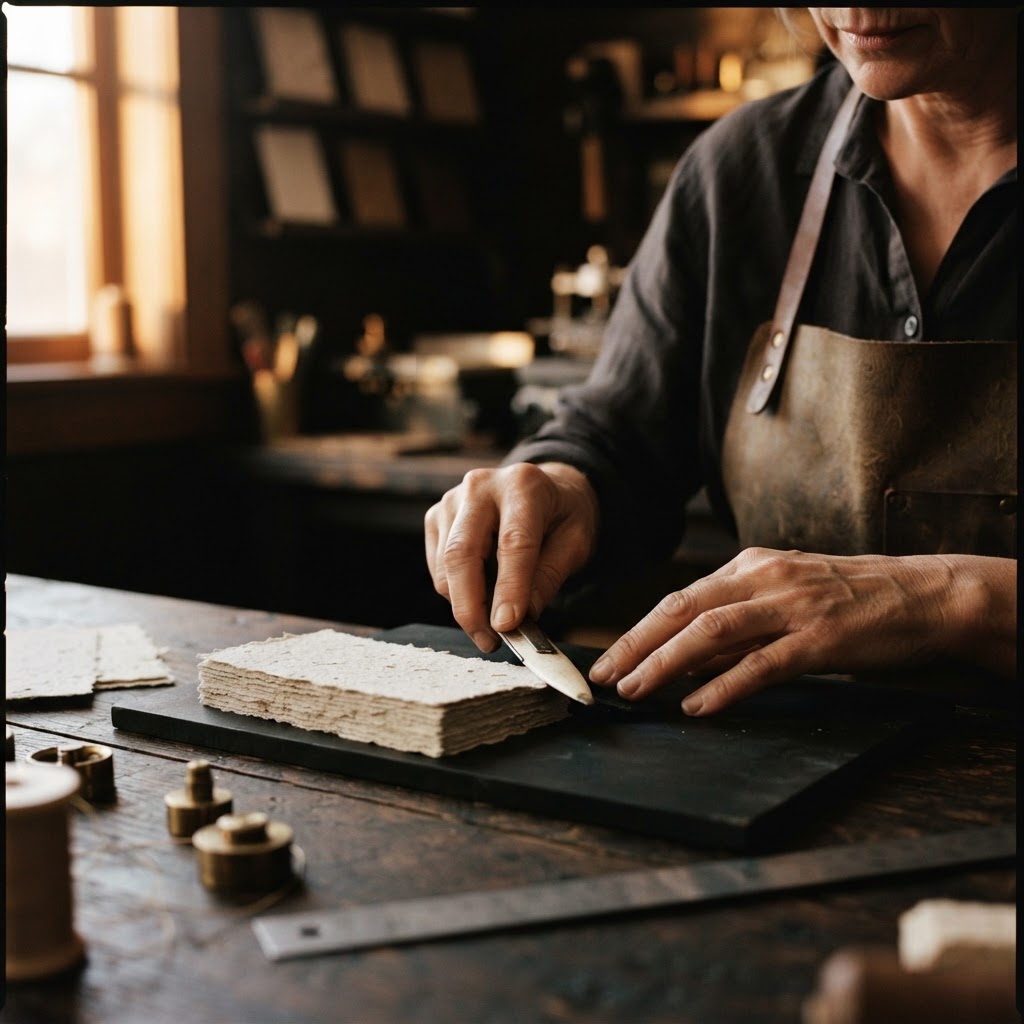
When a sheet of Renew Archive arrives at our workshop on the edge of the old city, it is already doing considerable work. Our role is not to overwhelm it. The paper earns its place in the design conversation. We set type carefully against its grain, often in letterpress, so the impression settles into the surface with the kind of permanence that digital printing cannot approach. The ink sits differently on recycled pulp. It absorbs with intention. The result is a card where every element, text, margin, negative space, feels deliberate.
For Priya, we worked with a single colour impression in a deep slate grey, her studio name set in a typeface drawn from architectural drafting traditions, her contact details in a smaller weight below. No embellishment that was not earned. The card's back was left to the paper itself, an expanse of Renew Archive's slightly textured surface that invited the hand to rest there.
We ran a proof on a Tuesday. By Thursday she had approved it without revision.
The Impact of Handing Over Something True
The Coorg resort project came through three weeks after that BKC meeting. Priya does not attribute it entirely to the card. She is too rigorous for that. But she speaks about the moment the executive picked it up as a turning point in the energy of the room.
"It made the conversation real," she said. "Before the card, I was a presenter. After it, I was a practitioner."
Over the following six months, Priya tracked something she had not tracked before: how often her cards came back to her. Not literally, but in the form of conversations that began with someone saying they had been given her card by someone else. A landscape architect in Bengaluru. A resort developer in Goa. A product designer who had picked up her card at a panel discussion and kept it in her wallet for two months before reaching out.
"She told me she kept it because it felt too good to throw away. I had never heard that about a business card before."
This is what materials do when they are chosen with intention. They extend the life of the object. A laminated card is a transaction. A Renew Archive card is an artifact. It stays in wallets. It sits on desks. It gets passed across tables and carried across cities. Each time it moves, it carries the brand of the person who gave it.
The Referral That Changed Her Quarter
In March, a hospitality consultant named Vikram called Priya's studio. He had received her card from a mutual contact at a sustainability conference in Delhi. He was looking for an architect for a boutique hotel project in Himachal Pradesh with a strict brief: the structure had to earn its place in the landscape. The budget was significant. The timeline was generous. The vision was exactly what Foundwork Studio had been building toward.
Vikram told her during their first call that he had looked at several practices. He had chosen to call Priya first because, as he put it, "the card suggested you understood what we were trying to do before I had explained it."
The project is currently in design development.
What a Card Can and Cannot Do
We want to be honest here, as we always try to be. A business card does not make a business. Priya's work is exceptional on its own terms. Her portfolio would have found its audience through other means. What the card did was compress time. It communicated values in the two seconds before a conversation began. It removed the friction of having to explain, repeatedly, what the studio stands for.
Renew Archive is not the most dramatic material in our atelier. It does not carry the visual weight of black cotton letterpress or the ceremony of foil on soft-touch velvet. What it does is carry authenticity without announcement. For founders whose work is rooted in considered choices, in the ethics of making, in the belief that how something is made is inseparable from what it is, it is often the most precise material available.
The slightly textured finish of Favini's recycled pulp is not a design flourish. It is evidence. Evidence of a process that chose not to take the easier path. And people feel that in their hands even when they cannot name what they are feeling.
A Quiet Confidence in the Exchange
Priya carries her Chhapai cards in a slim leather holder her partner gave her years ago. She does not hand them out at every opportunity. She is selective, as she is selective about everything. When she gives one, she gives it because she believes the person holding it will understand what it is saying.
She told us something at the end of our conversation that stayed with us. She said that before the Renew Archive cards, handing over her card had always felt like a small apology. A gesture that said: I know this is ordinary but here is my number. Now, she said, it feels like an extension of the work.
That is what we have always believed a Chhapai card should do. Not perform. Not announce. Simply carry, with complete fidelity, the conviction of the person who commissioned it.
Some things are made to be used and forgotten. And some things are made to be remembered long after the conversation that introduced them. The difference, more often than not, begins with the paper.